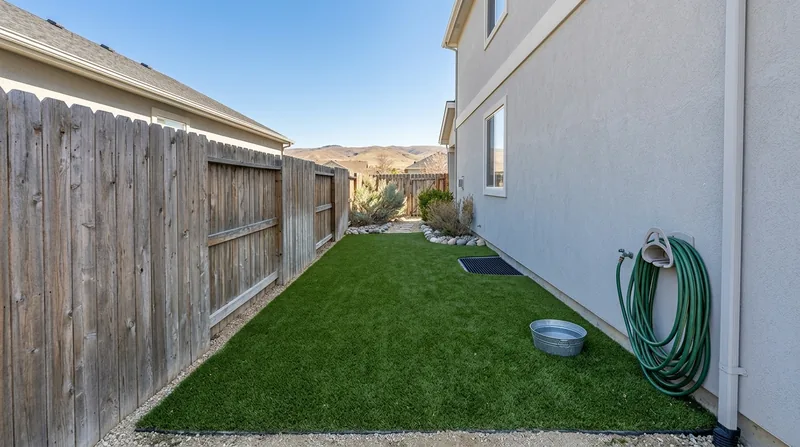




Pet Turf & Dog Run Installation in Boise solves the problem that every dog owner on the Bench, in the North End, or out in Eagle knows by late summer: a dirt track worn along the fence, goatheads embedded in paw pads, and a side yard that turns to mud after a thunderstorm. Boise's high-desert climate, with 100-degree dry summers and freeze-thaw winters, beats up natural grass fast, especially where a dog runs the same path every day. A perforated backing over a rinse-ready stone base lets urine, rain, and melting snow drain straight through, and an antimicrobial infill keeps odor down. The side yard stays usable the morning after a storm, and your dog stays clean. We've been installing artificial turf installation across Boise and the surrounding areas since 2013, and we spec every job in writing: product name, face weight, pile height, infill type, and base depth so you know exactly what you're getting.
Why Pet Turf Matters in Boise's Residential Yards
Boise homeowners face a real problem: Kentucky bluegrass lawns watered by pressurized canal irrigation work well in spring and early fall, but by mid-July the heat and the dog traffic combine. The silty soil over caliche hardpan on the Bench doesn't drain fast after a storm, and a dog's urine burns patches into the turf. A natural lawn in heavy shade under the maples and cottonwoods along the river can still thrive, but in the open yards of West Boise, Southeast Boise, and the newer subdivisions in Eagle and Star, the turf gets hammered. Pet turf solves this by design.
- A short, dense pile stands up to constant paw traffic without matting or thinning over time.
- Urine drains straight through the turf and the perforated backing into a stone base, so puddles and burn spots disappear.
- An antimicrobial infill (commonly zeolite or Envirofill) breaks down ammonia and keeps odor from building up in the yard.
- The surface stays cool underfoot compared to concrete, and a quick rinse cleans it after a muddy romp.
- No seasonal watering, no mowing, and no goatheads poking into paws year after year.
For dogs living in Boise's dry climate, pet turf is a game-changer. The drainage system is the key: without it, urine pools and odor takes over.
Key info: A homeowner in the North End with a 1920s bungalow, a big shade tree, and a golden retriever installed 400 square feet of pet turf in the side yard and a small dog run behind the garage. The turf drains into a gravel base, and the dog stays in that yard all day without tracking mud into the house. Total cost was in line with a season of lawn maintenance, and the yard is usable the day after a spring thaw.
For more information on regulations and best practices for residential yards in Ada County, see the Ada County website.
How We Install Pet Turf and Dog Runs in Boise
Pet turf installation is a sequence: site prep, base construction, turf laying, and infill. We start by inspecting the yard for drainage problems, existing irrigation lines, and low-voltage lighting wires that private locates don't mark. We call Idaho 811 before we dig, and we confirm the location of any underground utilities. The base is where drainage happens, so we spend time getting it right.
- We remove existing turf and grade the area so water flows away from the house and fences.
- We lay a geotextile membrane to prevent soil migration into the stone base.
- We compact a 2 to 3-inch stone base (typically 1.5-inch minus crushed granite or recycled asphalt) and verify drainage by running water across the site.
- We unroll the turf, cut it to fit the yard edges, and secure it with landscape staples and perimeter fasteners.
- We brush the pile upright and spread the antimicrobial infill (zeolite or Envirofill) at the rate specified for the turf.
- We make a final pass to settle the infill and ensure the turf looks uniform and the seams are tight.
A typical 400-square-foot dog run takes 2 to 3 days from excavation to finish. For more details on our turf installation process and other residential services, see our residential artificial grass installation page.
Real example: A homeowner in Star with a 1,200-square-foot yard and two large dogs wanted to keep the front lawn natural (HOA rules), but convert the side and back yards to pet turf. We installed 800 square feet of turf in the side and back, dug out the old grass, built a proper stone base, and installed a drainage swale along the back fence line. The dogs now have a clean, usable yard year-round, and the owner rinses the turf once a week in summer to keep it fresh.
Pet Turf Installation Methods and Approaches
| Approach | Description | Best for |
|---|---|---|
| Full yard conversion with drainage base | Remove turf, grade, lay geotextile, compact stone base, install turf and antimicrobial infill. | Yards with poor drainage, heavy dog use, or urine odor problems. |
| Dedicated dog run with reinforced base | Smaller area (400-600 sq ft) with extra-dense pile, thicker stone base, and higher infill rate. | High-traffic zones, multiple dogs, or yards where odor control is the top priority. |
| Hybrid yard (turf plus retained natural lawn) | Install pet turf in side and back, keep natural grass in front or shaded areas under trees. | HOA-restricted front yards, yards with good shade and drainage, or owners who want natural turf where dogs don't run. |
| Repair and odor treatment on existing turf | Clean turf, treat seams, refresh infill, and apply enzyme or antimicrobial treatment to odor hotspots. | Turf installed years ago, worn patches, or yards where infill has compacted and odor has built up. |
Pet Turf and Dog Run Installation Cost in Boise: What to Expect
Pet turf costs vary based on yard size, site prep complexity, the turf product and infill you choose, and whether the existing lawn needs to be removed. A simple 400-square-foot conversion with a standard drainage base and antimicrobial infill typically starts at $10 per square foot installed. Larger yards, difficult access, or extra drainage work can push the cost higher. The best way to know your price is to get a free estimate on site, because every yard is different.
Several factors move the price up or down. If the existing turf has to be hauled away, that adds labor and disposal cost. If the yard slopes or has clay soil that doesn't drain, we may need to build a thicker base or install a drainage swale, which increases material and labor. If you want a premium pet turf with a higher face weight and denser pile, that turf costs more than a standard product. The infill you choose also matters: zeolite is effective and widely used, while Envirofill is a premium option with slightly better odor control. For a detailed breakdown of pricing for different yard sizes and scenarios, see our pricing page.
We always recommend getting 2 to 3 estimates from local turf installers so you can compare price, product specs, and the base depth each company proposes. The cheapest estimate is often the riskiest: turf laid on bare dirt without a proper stone base will drain poorly, odor will build up, and you'll regret it in a year. A professional estimate includes the turf product name, face weight in ounces per square yard, pile height in millimeters, infill type and pounds per square foot, and base depth and compaction method. If an estimate doesn't include these details in writing, ask for them or move on.
Pet Turf and Dog Run Installation Near Me: What Boise Homeowners Should Know When Hiring
Hiring a turf installation company is an investment in your yard, so it's worth vetting the installer carefully. You're looking for a local, independent turf company that stands behind its work and can answer technical questions about the turf, the base, and the infill. Here's what to check before you sign a contract.
- Verify that the company carries a certificate of insurance naming general liability and workers' compensation coverage.
- Ask for a written spec of the turf product, face weight, pile height, infill type and rate, and base depth and compaction method.
- Request references from recent pet turf jobs in Boise or nearby areas, and call at least two to ask how the yard is holding up and whether odor is under control.
- Check that the company has a local address and phone number, not a call center or franchise operation.
- Ask about the warranty on the installation (not the turf itself, but the workmanship), and confirm it's in writing.
- If your yard is in an HOA, ask the installer for guidance on HOA submittals and color/pile approval, but understand that the HOA has final say and approval is not guaranteed.
A professional turf installation company will be happy to answer these questions and provide documentation. If an installer avoids your questions or quotes a price without seeing the yard, that's a red flag. For more information or to request a free estimate, contact us and we'll walk you through the process and answer any questions about pet turf and dog runs in Boise.
Pet Turf & Dog Run Installation in Boise: Pricing Guide
| Service | Price | Details |
|---|---|---|
| Standard pet turf installation (400-600 sq ft) | Starting at $10/sq ft | Includes turf removal, drainage base, antimicrobial infill, and full labor for small to medium dog runs |
| Large yard conversion (800-1,200 sq ft) | Starting at $10-12/sq ft | Cost per square foot may decrease with scale; site prep, drainage, and infill complexity affect final price |
| Difficult site or complex drainage | On estimate | Sloped yards, poor drainage, clay soil, or removal of old turf and debris require on-site inspection |
| Repair or infill refresh on existing turf | Starting at $8/sq ft | Cleaning, seam repair, and antimicrobial infill top-up for yards installed years ago or showing wear |
| Travel and estimate | Free | No charge for site visit or written estimate; response within 24 hours at (208) 567-4498 |
Indicative pricing, the exact cost depends on square footage, finish, and site access. Free personalized estimate within 24h at (208) 567-4498.


