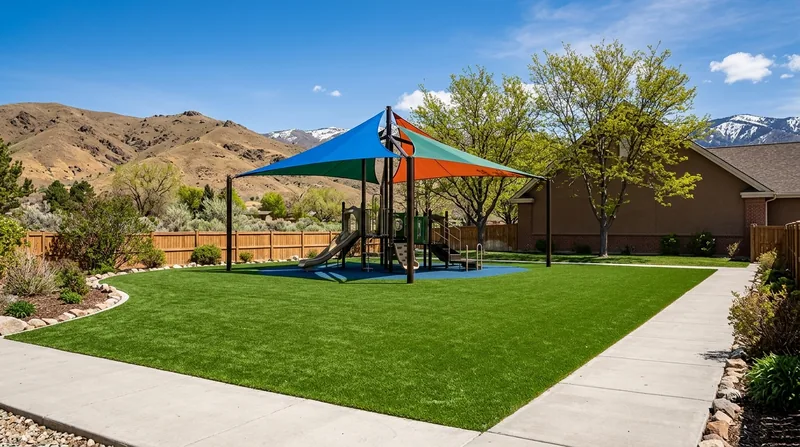




Playground and school turf in Boise replaces wood chips, pea gravel, and worn grass with a surface that drains fast, stays safe in snow, and handles freeze-thaw cycles without turning to mud. From daycares in Garden City to elementary schools on the North End, from church playgrounds in Eagle to HOA parks across the Bench, synthetic turf holds up to heavy foot traffic and freeze-thaw stress that real grass cannot survive in the high desert. We size padding to meet fall-height requirements for your equipment, schedule work around the school calendar, and install on occupied campuses without disrupting programs. Since 2013, we have installed turf at schools, churches, and community spaces throughout the Treasure Valley, specifying the product, face weight, pile height, and infill in writing before we start.
Why Playground Turf Matters in Boise's Freeze-Thaw Climate
Boise winters bring snow, ice, and the Treasure Valley's notorious spring snowmelt. Wood chips compact, rot, and wash away. Real grass dies under snow cover or drowns in spring runoff channeled by the caliche hardpan beneath the Bench. Playground turf drains immediately, resists compaction, and remains safe and playable year-round, even after the heaviest snowfall. The surface also eliminates the mud pit that forms around play equipment in March and April when the foothills melt and water seeks low ground.
- We select padding thickness matched to the fall height of your tallest equipment to meet ASTM safety standards.
- The base includes a perforated drain layer that channels snowmelt and spring runoff away from the play zone.
- Infill locks the turf fibers upright and cushions falls, staying stable through freeze-thaw cycles that heave real sod.
- The surface remains playable in snow and ice without becoming slippery or unsafe.
A properly installed playground surface protects children and keeps your facility open all season, even during Boise's wettest months.
Key info: Boise schools and parks must meet ASTM F1292 impact attenuation standards. We calculate the required padding depth based on your equipment's fall height and the ASTM impact energy threshold. This is not a guess; it is measured and documented before installation begins.
For more on how turf performs in harsh conditions, see our sports and gym turf page, which covers similar durability demands in a different context.
How We Install Playground Turf on School and Church Campuses in Boise
Installation on an occupied campus requires careful scheduling and a clean, professional crew. We work before school hours, during breaks, or in summer when the building is closed. The base preparation is the same as residential work: we remove the old surface, grade for drainage, compact the subgrade, lay perforated base material, and set the turf with seams that will not separate under foot traffic. For playgrounds, we add a thicker infill layer and ensure all seams are sealed and reinforced.
- We meet with the principal, facilities manager, or HOA board to confirm the schedule and any access restrictions.
- We call 811 to locate underground utilities and mark private irrigation lines, low-voltage lighting, and pet-fence wires by hand.
- We remove the old surface and grade the area to slope away from buildings and toward storm drains or low points.
- We compact the subgrade, lay the perforated base, and compact again to ASTM specifications.
- We roll the turf, cut seams to fit the space exactly, and seal every seam with adhesive and a reinforced tape.
- We apply infill in two passes, brushing the fibers upright after each pass, and rake the final surface level and uniform.
- We inspect the entire installation, test drainage, and confirm that all safety margins and equipment spacing meet your site plan.
From start to finish, a school or church playground typically takes two to five days, depending on the size and base condition.
Local example: A North End Boise elementary school replaced its wood chip play area with synthetic turf in June, two weeks before summer camp began. We worked early mornings and finished before the facility opened each day. The new surface is now used by summer programs, after-school care, and weekend community events without any drainage or safety issues, even during the wet springs that flood the benchland.
Learn more about our turf repair services if your playground surface needs seam work or spot repairs in the future.
Playground Turf Methods and Materials
| Approach | Description | Best for |
|---|---|---|
| Full replacement with certified padding | Remove old surface, grade, compact base, lay turf with infill matched to equipment fall height and ASTM safety standards. | New playground installations or complete surface failure. |
| Overlay on existing base | If the base is sound and drains well, we remove the old turf, level and compact the existing base, and install new turf over it. | Worn turf with a solid subbase and good drainage. |
| Seam repair and infill refresh | We seal separating seams, add or redistribute infill, and restore the playing surface without replacing the entire field. | Playgrounds with localized wear or seam failure. |
| Drainage correction under existing turf | If water pools or the base is soft, we remove the turf, grade and compact the subbase, add perforated drain, and reinstall turf. | Playgrounds with poor drainage or standing water after snow melt. |
Playground and School Turf Cost in Boise: What to Expect
Playground turf pricing starts at $10 to $15 per square foot installed, including the base, turf, and infill. The cost depends on the size of the play area, the condition of the existing ground, the fall height of your equipment (which determines padding thickness), and whether you need drainage correction. A small church playground (400 to 600 square feet) typically runs $4,000 to $9,000. A full school play area (2,000 to 5,000 square feet) ranges from $20,000 to $75,000. On-site estimates are free, and we provide a written spec before any work begins.
Factors that raise or lower the price include the depth of base material needed (caliche hardpan on Boise's Bench often requires more prep than North End silty soil), site access for equipment and trucks, whether the old surface must be hauled away, and whether we need to install new drainage. Visit our pricing page for detailed cost ranges and what is included at each tier.
We recommend getting estimates from at least two turf installation companies so you can compare pricing, base specs, and infill options. The cheapest estimate is often the riskiest: thin base, low-quality turf, and no written spec means you are gambling with your playground's safety and durability.
Playground and School Turf Near Me: What Boise Homeowners and Facilities Managers Should Know
Hiring a turf installation company near Boise starts with verifying that they understand your site's drainage, soil type, and safety requirements. Many crews lay turf on bare dirt with no base preparation, which fails in the Treasure Valley's spring runoff. A professional turf installer provides a written spec naming the turf product, face weight, pile height, infill type and pounds per square foot, and base depth and compaction method. Ask for references and photos of finished work, especially playground installations in similar climates.
For playground turf, confirm that the installer calculates padding thickness to meet ASTM F1292 impact attenuation standards for your equipment's fall height. If your school or HOA has architectural guidelines or a master plan, the turf color and pile height may require approval before work starts. We help with HOA and school district submittals, but we cannot promise approval. Permits for turf itself are rarely required in Boise, but if your project involves grading that changes drainage or work in a right-of-way, defer to the Ada County or city building department at your address.
Call us at (208) 567-4498 or visit our contact page for a free estimate. We respond within 24 hours and will walk your site to understand your drainage, equipment, and schedule before quoting any price.
Playground & School Turf in Boise: Pricing Guide
| Service | Price | Details |
|---|---|---|
| Small playground (400-600 sq ft) | Starting at $4,000 to $9,000 | Includes base prep, turf, infill, and padding sized for fall height. Pricing depends on existing ground condition and drainage needs. |
| Medium school or church play area (1,000-2,000 sq ft) | Starting at $10,000 to $30,000 | Full base installation, ASTM-compliant padding, sealed seams, and infill refresh. Caliche hardpan or poor drainage will increase base costs. |
| Large school playground (2,000-5,000 sq ft) | Starting at $20,000 to $75,000 | Multi-zone play areas with varying equipment heights, drainage correction, and phased scheduling around school calendar or occupied campus. |
| Drainage correction or base rebuild | On estimate | If existing ground pools water or base is soft, we remove turf, grade, compact, add perforated drain layer, and reinstall. Site visit required. |
| Seam repair or infill refresh | Starting at $1,500 to $5,000 | Seal separating seams, redistribute or top up infill, and restore playability without full replacement. Quoted after on-site inspection. |
| Free estimate | No cost, no obligation | We respond within 24 hours at (208) 567-4498. Site visit includes drainage assessment, equipment fall-height check, and written spec before any quote. |
Indicative pricing, the exact cost depends on square footage, finish, and site access. Free personalized estimate within 24h at (208) 567-4498.


